


Home / Guides / Dust, heat & old frames
Dust, heat and old frames: what actually ages a door out here
Coastal door companies talk about salt because salt is their enemy. Cessnock is an hour inland and our doors die differently: slowly, dryly, and mostly from three things nobody watches. Here's what they are, what you can safely check yourself this weekend, and where the hard line sits between owner jobs and technician jobs.
Enemy one: dust
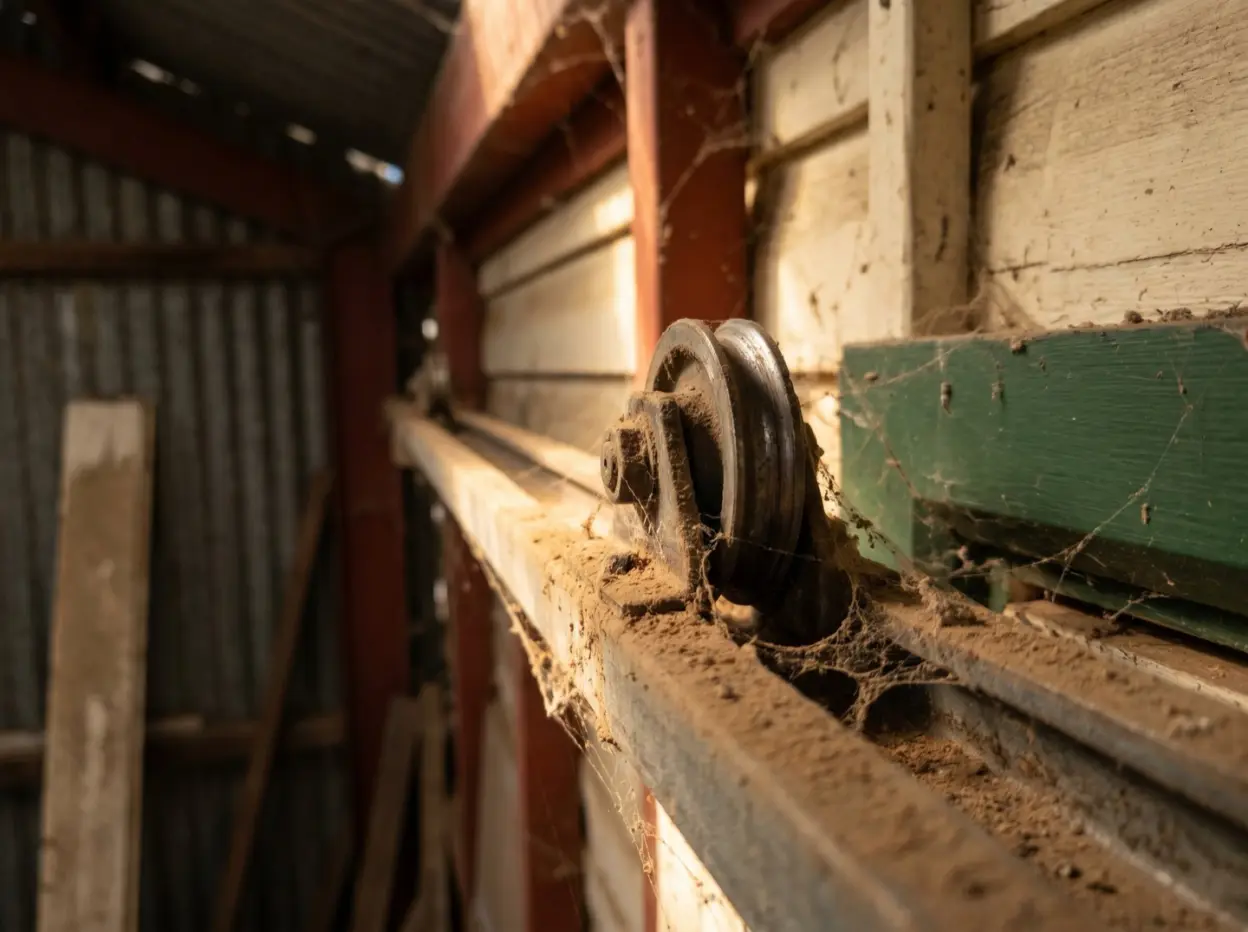
Dry summers, paddock edges and gravel drives keep a fine grit moving through the air most of the year, and a garage door is a machine that lives outside with its bearings exposed. On its own, dust is cosmetic. Mixed into old grease on a track or a roller bearing it becomes a grinding paste, and every cycle of the door laps a little more metal away. That's why a door on a gravel drive "gets old" years before the same door on a sealed street.
Dust has a second trick on newer doors: it films over the photo-eye safety sensors near the floor, and the opener, quite correctly, refuses to close on a sensor it can't trust. If your sectional opens fine but won't close, or closes only while you hold the wall button, check the two little lenses down near the tracks before you conclude the opener has died.
Safe owner jobs: wipe the photo-eye lenses with a dry soft cloth; brush loose dust and cobwebs out of the visible track; keep the concrete near the guides swept. Not owner jobs: re-greasing or adjusting anything under load, forcing a door that grinds mid-travel.
Enemy two: sun and heat
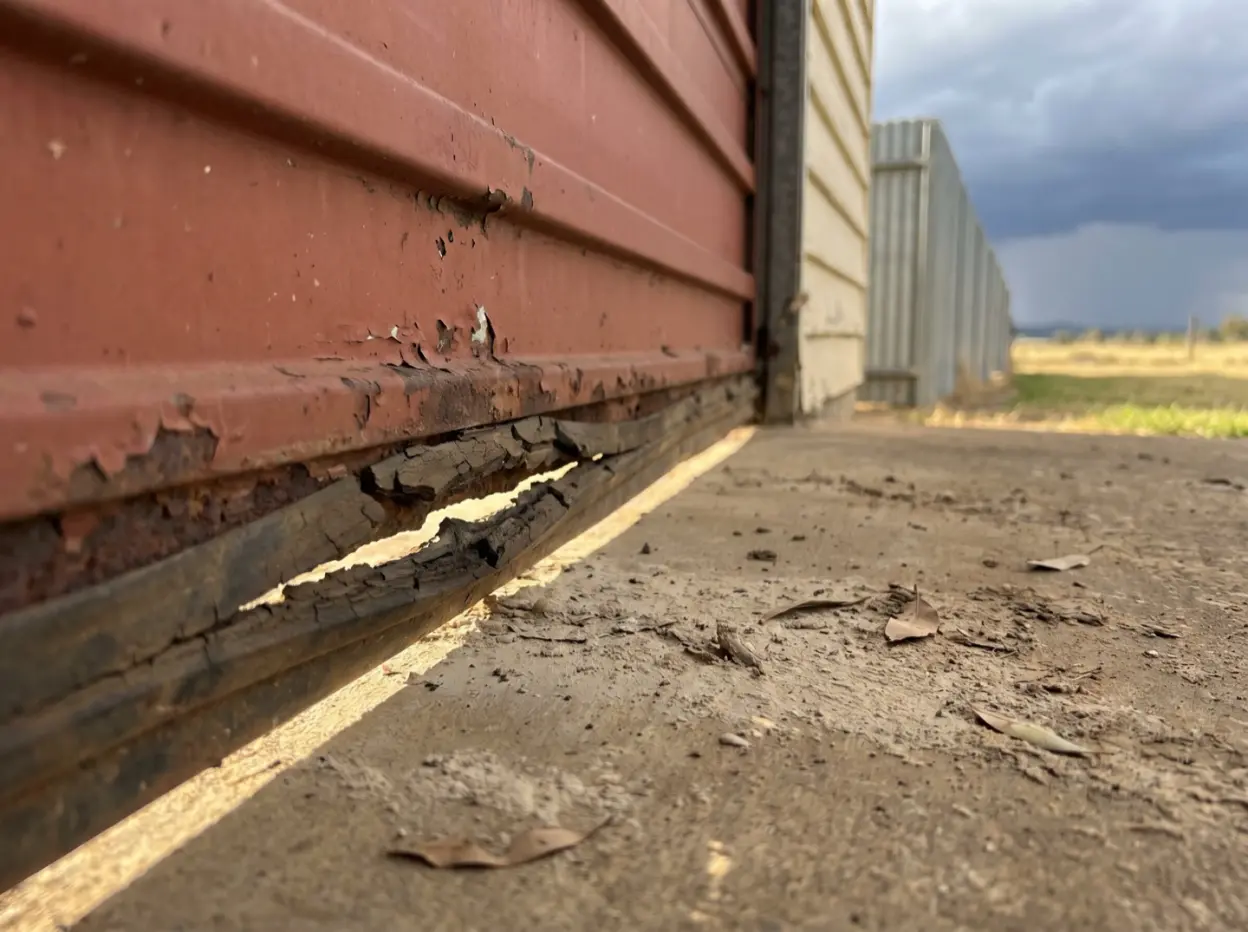
A west-facing steel door in a Cessnock January sits in the high twenties or worse for weeks, bakes through the afternoon, then cools overnight, day after day. The steel handles it. The rubber and plastic don't. Bottom seals go hard, crack and crumble; weather strips curl; plastic rollers and guide blocks get brittle. A perished bottom seal isn't just a draught: it's the gap that lets dust reach the tracks and storm water reach whatever's stored against the back wall, which out here is often the gear that earns.
Safe owner check: close the door on a sunny day and look along the bottom edge from inside. A clean dark line means the seal is doing its job. A broken line of daylight means it isn't, and everything that line lets in is now your garage's weather.
Enemy three: the frame that never stops moving
The grid's garages are timber-framed, and timber moves with moisture: shrinking through the dry, swelling after the storms that break it. Over decades that movement leans jambs and sags lintels, and the door bolted to that timber gets asked to run out of square. The tell is a door that scrapes at one corner, yawns at the opposite one, or "jams in winter but it's fine in summer." That's not a door fault. It's the building talking, and it's why some doors get "repaired" every year until someone finally measures the frame.
There's a longer discussion of what frame movement means for the fix-or-replace call in the repair-or-replace guide.
The five-minute seasonal look
Four checks, all from floor level, none requiring tools. If any of them fails, that's what the form is for.
- Listen: a healthy door is quiet. New grinding, banging or squealing is wear announcing itself early, which is the cheap time to catch it.
- Look at the bottom edge: daylight through the closed seal, or crumbled rubber on the floor, means the seal is done.
- Look at the gaps: even gaps around a closed door mean a square frame. A wedge-shaped gap means movement.
- Test the auto-reverse (openers only): lay a solid object like a timber offcut flat where the door lands and close the door with the remote, standing clear. The door should touch and reverse. If it doesn't, stop using the opener until it's looked at; that reverse behaviour is the core safety feature Australian standards expect of a powered door.
Why we bang on about this
Because prevention is genuinely cheaper here, and not as a slogan. The inland enemies are slow: dust grinds over months, seals perish over years, frames move over decades. Every one of them gives you a long window where a small visit fixes what a big visit would later replace. A door that gets its seals renewed and its tracks cleaned when the grinding starts routinely sees out another decade. The doors that make the urgent list are nearly always the ones nobody listened to.
Sources & further reading
- AS/NZS 60335.2.95, the Australian safety standard for powered garage door drives, is the reason the auto-reverse test above matters: it's the behaviour a compliant opener is built to show.
- ACCC Product Safety: garage door openers carries recalls and safety notices, worth a scan if your opener came with the house and its history didn't.
- Electrical work licensing (NSW Government): any mains wiring an opener installation needs is licensed electrical work in NSW, which is why that part of the job always goes to a licensed electrician.

Failed one of the checks?
Say which check and what you saw; that one sentence usually tells us what to bring. Early wear is a service call, not a crisis, and it's the cheapest visit we do.
No call centre, no run-around
Tell us about the door
A few lines on the form reach a person who knows doors, not a queue. If it is urgent, say so in the message and lead with your phone number.