Garage door repairs, openers & new doors in Cessnock
Four jobs, done properly.
Everything we do fits on one board: repairs when a door fails, openers and remotes when the automation misbehaves, new doors when the old one has done its time, and tune-ups that catch wear while it's still the cheap kind. Here's what each visit actually looks like.
Job sheet 01 · urgent
Repairs
The urgent list is the same across the coalfields: a spring that let go with a bang, a lift cable frayed through, a door that's jumped its track, rollers worn to the point of grinding. On the older doors in the grid, a door that's "gone heavy" overnight is nearly always spring tension gone, not you getting weaker.
What happens on the visit
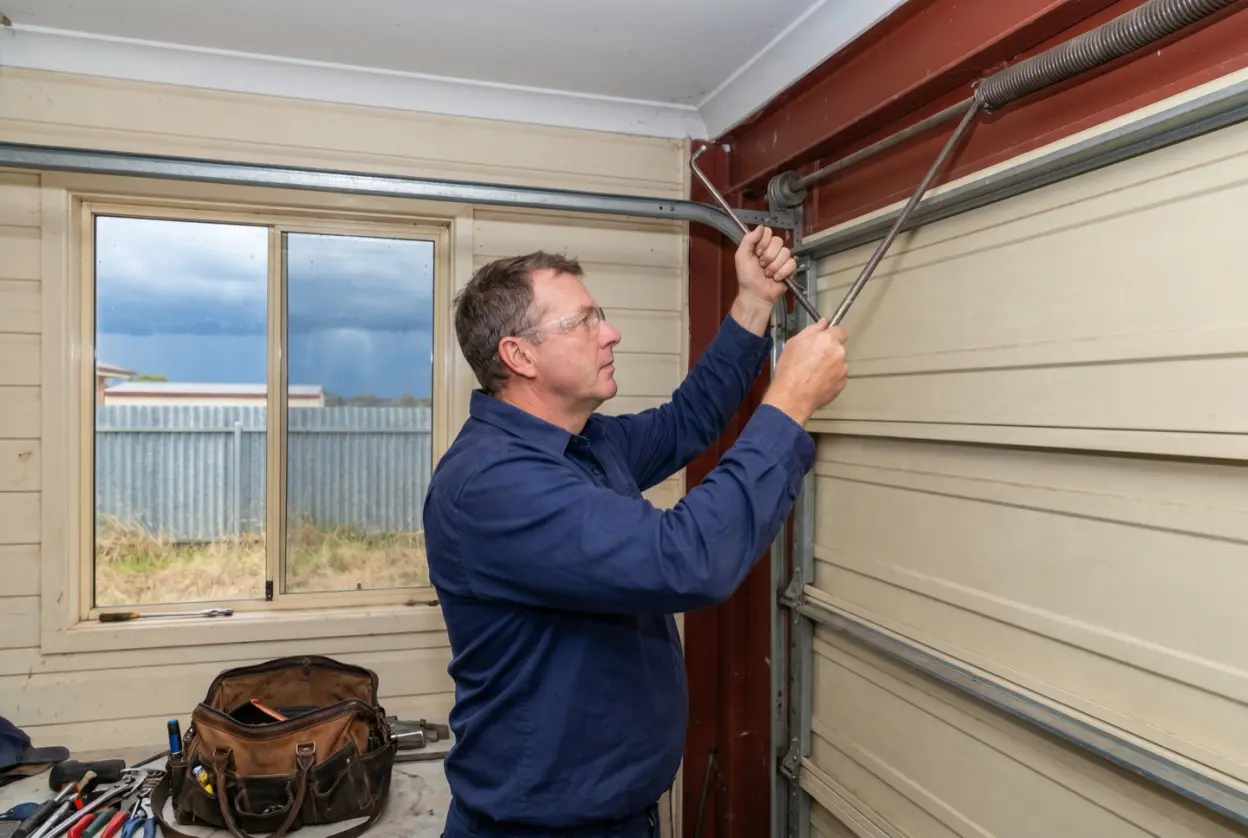
The technician looks at the whole system, not just the loud part: springs, cables, tracks, rollers, drums and the fixings into the frame.
You get told what failed, what it stresses next, and what it costs to put right, before any work starts.
Most repairs are done on the spot from stock parts; odd sizes get measured and ordered.
The usual culprits
Torsion and extension springs at the end of their cycle life
Frayed or snapped lift cables
Doors off the track, bent or misaligned track
Seized rollers, worn hinges, loose fixings in old timber
The safety line: a garage door spring is under serious tension even when the door looks dead. If the door dropped suddenly or sits crooked, don't unbolt anything and don't try to wind a spring yourself. That one is never a DIY job, and it's the most common way people get hurt by these doors.
How pricing works: a call-out to look and quote, then a firm price on site before any work starts. No figures invented here; the quote is the quote.
Job sheet 02 · the automation
Openers & remotes
Half the "broken door" calls in the growth belt are really opener calls: the motor runs but nothing moves, the door reverses for no reason, the remote works from the driveway but not the street. Out here there's a local wrinkle too: dust films over the photo-eye safety sensors and the door refuses to close, which reads as a fault but is really housekeeping.
What we sort
Openers that won't drive, stall mid-travel or reverse unprompted
New opener supply and fit, sized to the door's real weight and balance
Remotes, wall buttons and keypads: replaced, re-coded, synced
Safety-beam faults, limit and force settings set properly
Worth knowing
An opener can't fix an unbalanced door; if the springs are tired, the motor is doing work it wasn't built for. Balance gets checked first, every time.
Any mains wiring an opener needs is electrical work, and it's done by a licensed electrician. Whether your job needs it gets confirmed on site.
Bring the remote brand and the door type to the form if you know them; it shortens the conversation.
Job sheet 03 · considered
New doors
When a coalfields original has genuinely done its time, or a shed needs a wider, higher opening than it was built with, we measure, quote and fit new sectional, roller and tilt doors. The right type depends on the opening, the headroom and what the door has to guard; the right look usually means matching the house, not the catalogue.
The types, honestly
Sectional (panel-lift): the modern default for double garages; needs headroom and side room for tracks.
Roller: the coalfields and shed workhorse; tight on headroom, kind on side room, and the only sane choice for many old openings.
Tilt: the one-piece original; still right for some narrow, shallow garages in the grid.
What the visit looks like
A free measure and quote at the house: the opening, the headroom, the frame's condition, and what you're storing all get looked at.
A written quote for the door, the motor if wanted, and the fit-off. Fixed once you accept it.
Old door taken away; new door balanced, locked and handed over working.
New doors are measure-and-quote work: nobody honest can price one without seeing the opening.
Job sheet 04 · preventive
Service & tune-ups
The cheapest repair is the one that never becomes a repair. A service visit rebalances the door, re-tensions what's drifted, lubricates what's dry, and replaces the small parts that are about to become big parts: worn rollers, tired hinges, perished bottom seals. On dusty blocks and gravel drives this matters double, because grit is what ages these doors out here, not rain.
A tune-up covers
Spring tension and door balance checked and set
Tracks cleaned and aligned, rollers and hinges lubricated or swapped
Bottom and side seals checked against dust and storm water
Opener force, travel limits and the auto-reverse safety test
When it's worth booking
The door's grinding, banging or noticeably heavier than it was
It's been years since anyone looked at it and it works "mostly"
You've just bought the place and the door's history is a mystery